

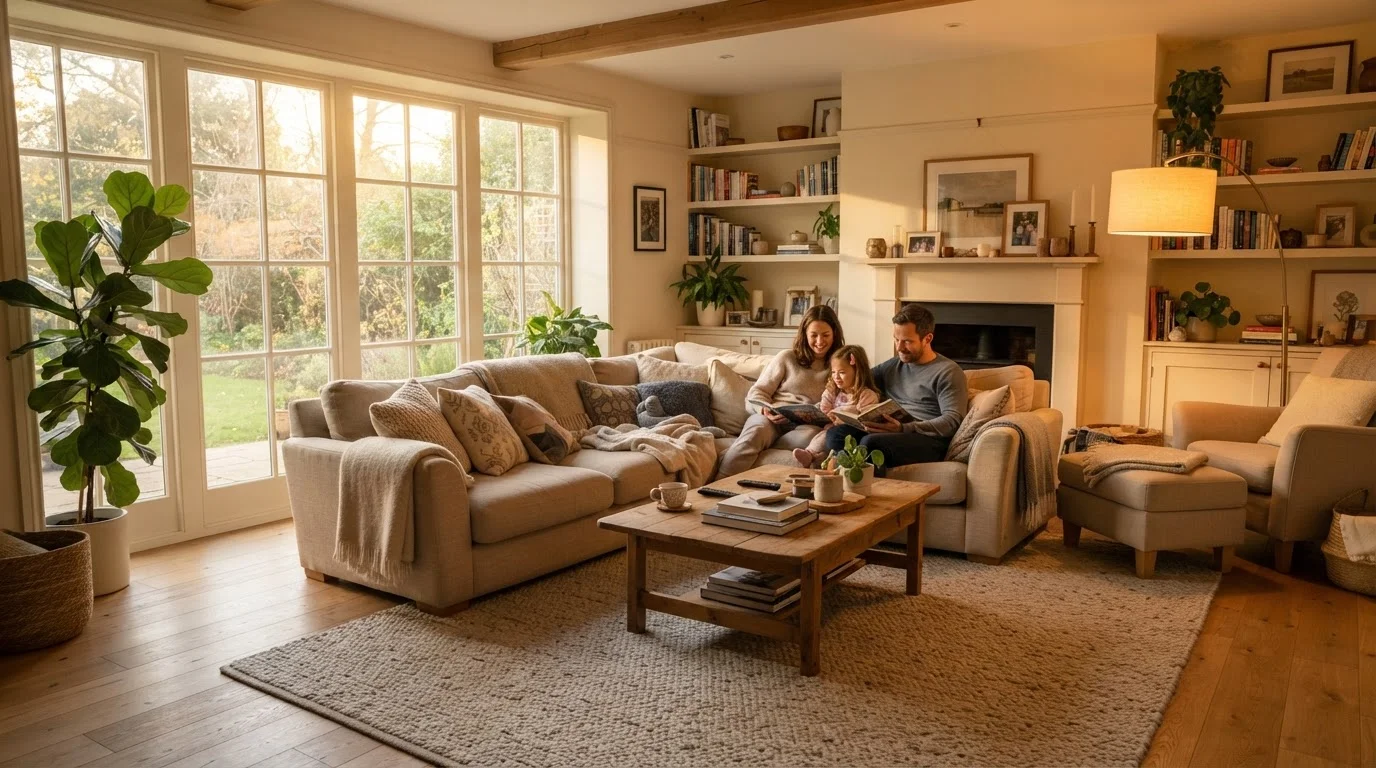
Key Takeaways
- Natural light costs nothing to run but depends on window placement, season, and local climate.
- Artificial lighting gives you precise control over brightness and color temperature at any hour.
- Exposure to natural light during daytime hours can support sleep and mood, according to sleep research.
- LED artificial lighting has reduced the energy cost gap between the two sources significantly.
- Most homes benefit from combining both sources rather than relying on one alone.
- Simple changes like repositioning furniture or adding reflective surfaces can extend how far natural light reaches.
Option A
Natural light
The free, health-linked option tied to sun and season.
Best for: Daytime living spaces where windows, skylights, or solar tubes can be positioned to capture direct or diffused sunlight.
Option B
Artificial light
The controllable, year-round solution independent of weather or time of day.
Best for: Rooms with limited window access, evening use, task lighting, and situations where consistent brightness is a priority.
If you want to lower electricity costs during daytime hours
Natural light
Sunlight through windows costs nothing to generate. Maximizing it with light-colored walls and strategic window coverings can meaningfully reduce daytime lighting loads.
If consistent brightness for evening tasks or remote work matters most
Artificial light
Artificial light delivers steady, adjustable illumination regardless of time, season, or weather, making it the practical choice for focused work after dark.
If you are concerned about sleep quality and circadian rhythm
Natural light
Daylight exposure, especially in the morning, helps regulate the body's internal clock. Limiting bright artificial light in the evening is also part of this picture.
If you rent or cannot make structural changes to your home
Artificial light
Lamps, bulbs, and dimmers require no permits or renovation. You can adjust color temperature and placement without touching walls or windows.
What each source actually provides
Natural light is sunlight that enters a home through windows, skylights, glass doors, or solar tubes. Its intensity, color, and angle shift throughout the day and across seasons. Morning light tends toward cooler blue tones; late afternoon light shifts warmer. Cloudy days reduce intensity without eliminating it entirely.
Artificial light covers any electrically powered source: incandescent, fluorescent, halogen, or LED. Each type produces a different color temperature, measured in Kelvins. Bulbs labeled around 2700K produce warm, yellowish light similar to incandescent. Bulbs at 5000K or above produce a cooler, bluer light closer to midday sun.
The distinction matters because the color and intensity of light affect how alert or relaxed people feel, how colors in a room appear, and how much a room costs to illuminate. See our household energy reference for context on how lighting fits into your overall electricity use by room.
| Criterion | Natural light | Artificial light |
|---|---|---|
| Operating cost | None | Monthly electricity cost |
| Availability | Daytime only, weather-dependent | Any hour, any conditions |
| Color temperature | Shifts naturally with time of day | Fixed unless bulb is replaced |
| Glare control | Requires blinds or shading | Controlled by fixture and dimmer |
| Circadian support | Natural alignment with day/night cycle | Depends on timing and bulb type |
| Installation changes needed | Often yes, for new windows/skylights | Usually no, bulbs and lamps only |
| Energy use | Zero electricity | Low with LED bulbs |
Health and mood: what the research says
Light exposure influences circadian rhythms, the internal timing system that regulates sleep, alertness, and hormone release. The National Institute of General Medical Sciences describes circadian rhythms as physical, mental, and behavioral changes that follow a roughly 24-hour cycle, driven primarily by light and darkness.
Morning exposure to bright, cool-toned light (whether natural or artificial) can help set the circadian clock and improve alertness. Dim, warm light in the evening allows melatonin to rise more naturally. Bright artificial light late at night, particularly from screens or overhead LEDs, can delay that melatonin rise and make sleep harder to initiate.
Natural light carries an advantage here because its color temperature shifts automatically with the time of day. Artificial lighting stays constant unless you manually adjust it or use a programmable system. Families who work or study at home during daytime hours may find that positioning desks near windows is a low-cost way to get that daytime light exposure without any added electricity cost.
Energy use and running costs
Natural light has no operating cost. The expense shows up in construction or renovation: adding a window, skylight, or solar tube requires permits in most jurisdictions and professional installation for anything involving structural work or roofing. For renters or families not planning renovations, those changes are usually off the table.
Artificial lighting does carry a monthly cost, but that cost has dropped substantially as LED bulbs have become standard. The U.S. Department of Energy notes that LED bulbs use at least 75% less energy than traditional incandescent bulbs. A household that replaces incandescent bulbs with LEDs can see a noticeable reduction in lighting-related electricity use without touching its windows.
Where natural light is available, using it instead of switching on overhead fixtures during daytime hours is the simplest way to reduce lighting costs. Light-colored walls, mirrors, and glossy surfaces help distribute natural light further into a room, extending its reach without any electrical draw.
75%+
Energy saved by LED vs. incandescent bulbs
The U.S. Department of Energy states LED bulbs use at least 75% less energy than traditional incandescent bulbs.
24 hours
Length of a human circadian cycle
The National Institute of General Medical Sciences describes circadian rhythms as roughly 24-hour cycles driven primarily by light and darkness cues.
Practical tradeoffs for everyday family life
Natural light has real limits. It disappears after sunset, weakens significantly on overcast days, and varies by which direction a room faces. North-facing rooms in the northern hemisphere receive indirect, diffused light year-round. South-facing rooms get more direct sun but can overheat in summer without shading.
Glare is another common complaint. Unfiltered sunlight on a screen or work surface is uncomfortable and can cause eyestrain. Sheer curtains, adjustable blinds, or exterior overhangs manage glare while still allowing light in.
Artificial light fills those gaps reliably, but the quality of that light depends on bulb choice and fixture placement. A single overhead fixture often produces harsh shadows and uneven coverage. Layered lighting, combining overhead, task, and accent sources, gives a room more flexibility and generally makes it more comfortable to use.
For most families, the practical answer is a combination: maximize natural light where window placement and home orientation allow it, then use artificial lighting to fill gaps in the evening, in lower-lit rooms, and for task-specific needs. That approach keeps both energy costs and lighting quality in a reasonable balance.