

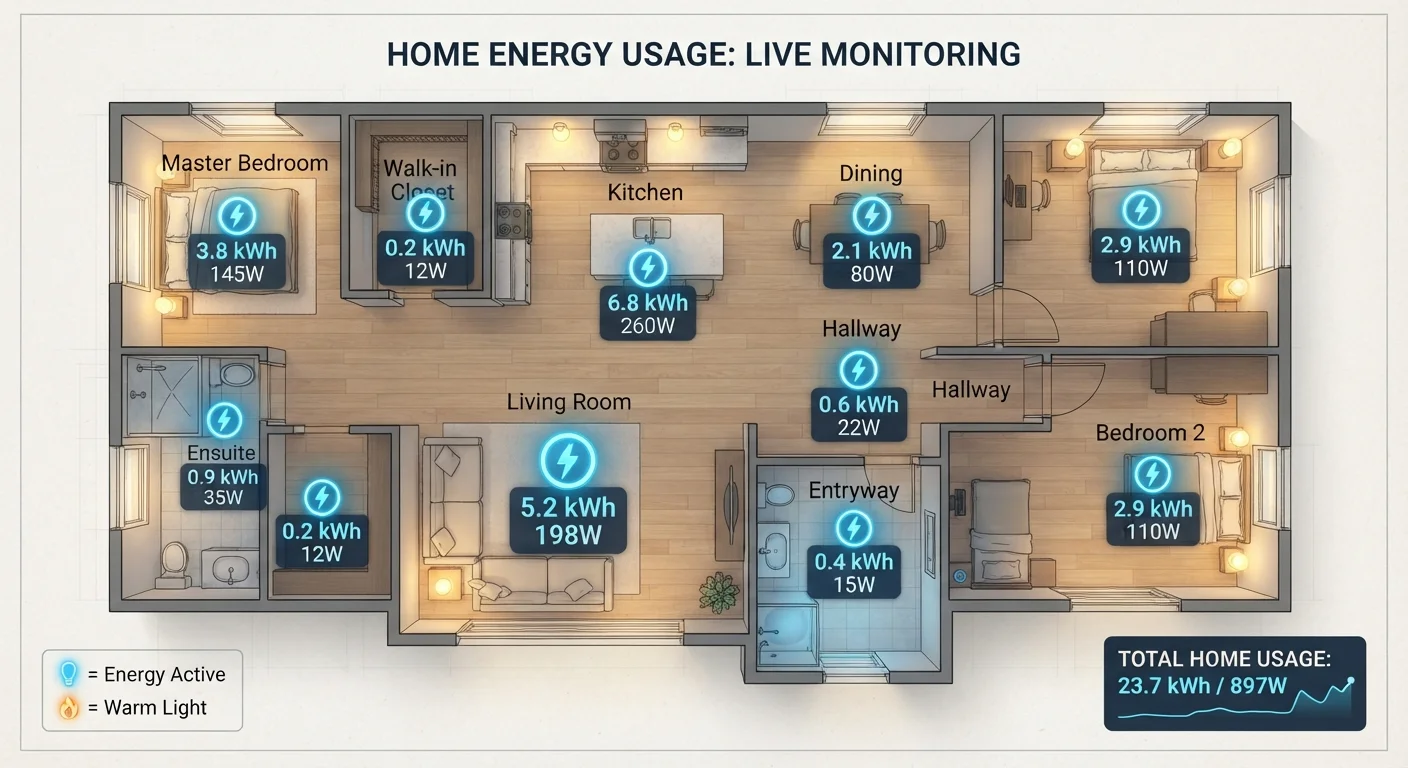
Why energy use differs by room
Your electric bill is a single number, but the energy behind it comes from dozens of separate sources spread across your home. Understanding which rooms and appliances draw the most power helps you see where changes in habits or equipment would have the most impact.
A typical U.S. household uses roughly 10,500 kilowatt-hours (kWh) per year, according to the U.S. Energy Information Administration (EIA). That consumption is not spread evenly. Heating, ventilation, and air conditioning (HVAC) equipment alone accounts for about 46% of total home energy use, according to EIA data, which means the rest of the house splits the remaining share among water heating, major appliances, lighting, and electronics.
Room-level awareness matters because the same behavior, such as leaving a light on overnight, costs very different amounts depending on whether that light is an LED bulb in a bedroom or a heat lamp in a bathroom. Context makes the numbers useful.
Room-by-room energy breakdown
Kitchen
The kitchen is typically the second-highest energy zone in a home. The refrigerator runs continuously and uses roughly 400 to 600 kWh per year depending on size and age. An electric range or oven draws 1,000 to 2,000 watts when in use. A dishwasher adds about 1,200 to 2,400 watts per cycle, most of that going to the heating element that dries dishes.
Laundry room
Electric clothes dryers are among the largest single-appliance loads in a home, typically drawing 4,000 to 6,000 watts per cycle. Washing machines use far less electricity, around 500 watts, but hot-water wash cycles shift some of that cost to your water heater. Running a dryer five times a week can add roughly 25 to 40 kWh weekly, depending on cycle length and load size.
Living room and home office
Televisions, game consoles, streaming devices, and desktop computers are moderate individual loads, but they tend to run for many hours each day. A large LED television uses about 100 to 200 watts. A gaming console can draw 150 to 300 watts during active play. Standby power, sometimes called phantom load, from devices left plugged in and off can account for 5% to 10% of total household electricity use.
Lighting in these spaces has changed significantly as LED bulbs replaced incandescent ones. A 60-watt equivalent LED uses about 9 watts, so even leaving lights on longer has a smaller impact than it once did. For a deeper look at how your lighting choices affect both energy costs and daily comfort, see our guide to natural versus artificial lighting.
Bathroom
Bathrooms use less electricity than kitchens but can have hidden costs. An electric in-wall or radiant floor heater draws 750 to 1,500 watts. A hair dryer uses 1,200 to 1,875 watts during each use. The bigger bathroom energy cost is often hot water: long showers pull from your water heater, which is one of the top three energy consumers in most homes.
Bedroom
Bedrooms are typically the lowest-consumption rooms during waking hours. The main draws are lighting, phone chargers, and alarm clocks, all of which are small loads. However, window air conditioning units, where used, change that calculation significantly. A window AC unit rated for a medium room draws roughly 900 to 1,440 watts.
Basement and garage
Secondary refrigerators and chest freezers in basements or garages can add 400 to 800 kWh per year each. Older units tend to use more than newer ones. A chest freezer in an unconditioned garage may work harder in summer heat, increasing its consumption further.
What HVAC really costs
Whole-home heating and cooling dwarfs every other category. A central air conditioner typically draws 3,000 to 5,000 watts when running. A gas furnace uses less electricity (mainly for the blower motor, around 400 to 800 watts), but its fuel cost is separate and tracked in therms or cubic feet rather than kWh.
The number of hours HVAC equipment runs each day, called runtime, varies by climate, insulation quality, thermostat settings, and how well the home is sealed. Leaky ductwork alone can reduce system efficiency by 20% to 30%, according to the U.S. Department of Energy. Seasonal maintenance, such as changing air filters and having ducts inspected, directly affects how long equipment runs to reach your target temperature. For a checklist of those tasks, see seasonal home maintenance tasks most families overlook.
Kilowatt-hour (kWh)
The standard unit for measuring electricity consumption on your bill. One kWh equals using 1,000 watts of power for one hour, such as running a 100-watt bulb for 10 hours.
Phantom load
Electricity drawn by devices that are plugged in but switched off or in standby mode. Common sources include televisions, game consoles, phone chargers, and cable boxes.
Time-of-use (TOU) rate
A utility pricing structure where the cost per kWh changes depending on the time of day. Electricity typically costs more during high-demand periods such as weekday afternoons.
Runtime
The number of hours per day that an appliance, particularly HVAC equipment, operates. Higher runtime means higher energy consumption, even if the appliance is the same model.
HVAC
Short for heating, ventilation, and air conditioning. This category includes furnaces, central air conditioners, heat pumps, and the ductwork and blower systems that distribute conditioned air.
Reading this information on your utility bill
Most utility bills show total kWh used for the billing period compared to the same month in the prior year. Some utilities also provide an online dashboard that breaks down usage by day or time of day, which is useful for identifying spikes tied to specific appliances or habits.
Time-of-use (TOU) rate plans, where electricity costs more during peak demand hours, make room-level awareness more financially relevant. Running a dishwasher or dryer during off-peak hours, typically late evening or early morning, can reduce the cost of those cycles without changing how often you use them.
Home energy monitors, which attach to your main electrical panel, can show real-time and historical consumption by circuit. These tools range from simple plug-in meters that track individual appliances to whole-home monitors that require professional installation involving your electrical panel. For any work involving your electrical panel, consult a licensed electrician.
General home energy use information, like this article, is educational. Your actual consumption will vary based on home size, local climate, equipment age, and household habits. For guidance specific to your home and situation, your local utility's energy audit program or a certified home energy assessor can give you data grounded in your actual usage.