

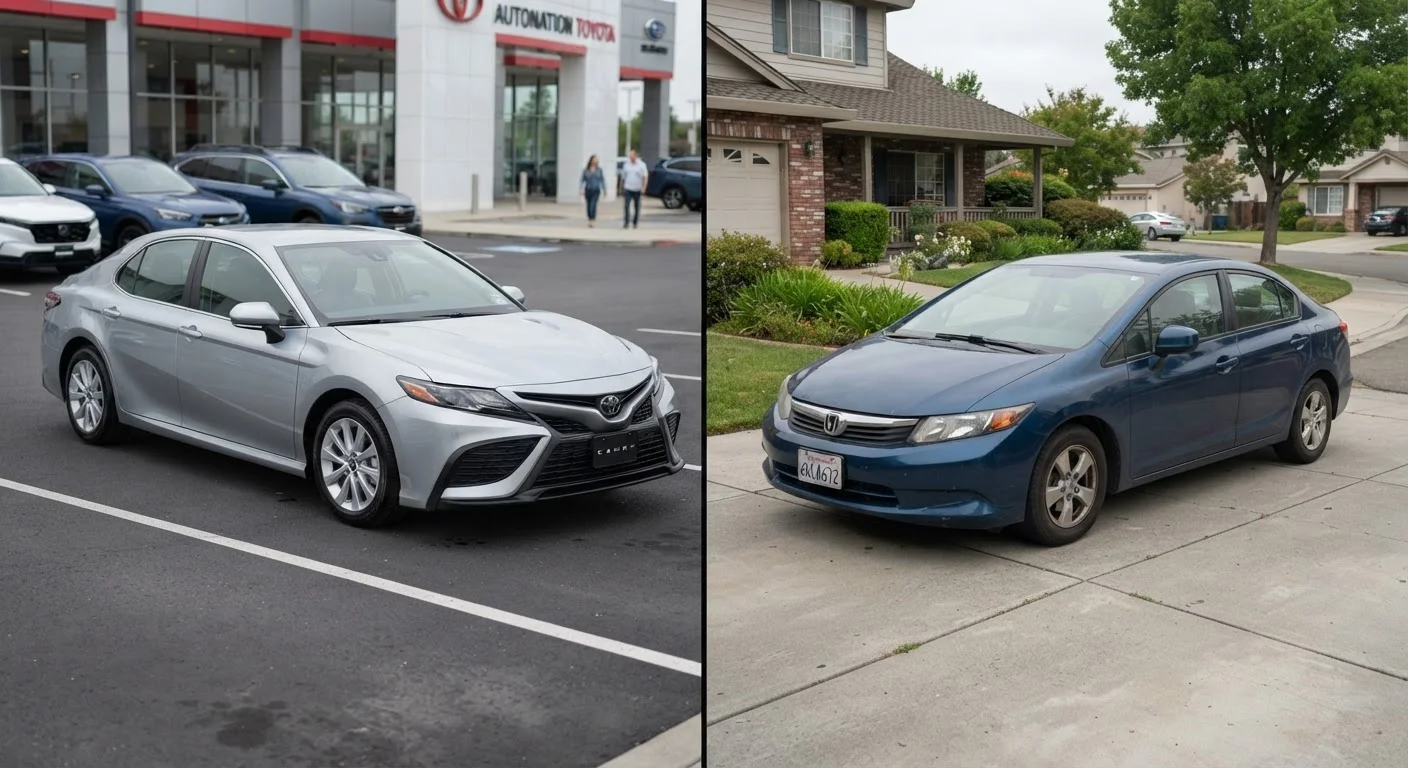
Key Takeaways
- New cars lose roughly 20% of their value within the first year of ownership.
- Used cars typically cost less upfront but may carry higher maintenance and repair expenses.
- Loan interest rates for used vehicles are generally higher than rates for new vehicles.
- The smartest financial choice depends on your budget, driving habits, and risk tolerance.
- Total cost of ownership, not purchase price alone, is the most useful number to compare.
Our Verdict
New cars offer lower repair risk and better financing rates, but depreciation erodes their value quickly. Used cars reduce upfront spending and slow depreciation loss, though older vehicles can carry unpredictable maintenance costs. Neither option is universally better; the right call depends on how long you plan to keep the vehicle and how much financial cushion you have for repairs.
| Best for | Recommended |
|---|---|
| Families who want predictable costs and plan to keep the vehicle long-term | New car |
| Households with tighter budgets who can handle occasional repair expenses | Used car |
| Buyers who want to minimize depreciation loss from day one | Used car |
| Buyers who qualify for manufacturer financing incentives at low rates | New car |
Why the sticker price is only part of the story
Most car-buying decisions start with monthly payment math, but the real financial difference between new and used vehicles plays out over years. Depreciation, interest costs, insurance premiums, and repair bills all shift the equation in ways that a purchase price alone cannot capture. For American families managing household budgets, understanding what total car ownership actually costs is more useful than comparing window stickers.
A new vehicle typically starts depreciating the moment it leaves the lot. According to data published by Edmunds, a new car loses roughly 20% of its value in the first year and around 40% to 50% within three years. A used car that is two or three years old has already absorbed that steepest decline, so the buyer avoids it entirely. That difference in value trajectory is one of the strongest financial arguments for buying used.
That said, used cars carry their own financial risks. A vehicle with 60,000 miles or more may need tires, brakes, or other maintenance work that a new-car buyer would not face for years. Warranty coverage is usually limited or absent. These variables make the comparison more complex than a simple price gap.
Depreciation: the cost new-car buyers absorb
Depreciation is the single largest ownership cost for most new-vehicle buyers. Because the steepest drop happens early, a buyer who trades in or sells after two or three years absorbs that loss without recovering it. A buyer who holds the vehicle for eight or ten years spreads the depreciation across more miles and more time, which makes the per-year cost far lower.
Used-car buyers sidestep the sharpest depreciation curve. A three-year-old vehicle in good condition loses value more gradually, and a buyer who holds it for five or six additional years faces a much smaller annual depreciation cost. This is why financial planning resources often describe buying a two-to-four-year-old used vehicle as one of the more cost-efficient ownership strategies, assuming the vehicle has a solid maintenance history.
| New car | Used car | |
|---|---|---|
| Upfront purchase price | Higher | Lower |
| Depreciation in year one | Steep (up to 20%) | Much slower |
| Typical loan interest rate | Lower | Higher by 1-4 points |
| Factory warranty coverage | Full coverage included | Limited or absent |
| Insurance premiums | Generally higher | Generally lower |
| Short-term repair risk | Low | Moderate to high |
| Best ownership horizon | 7+ years | 5-6 years or more |
The depreciation advantage of used cars is most pronounced in the first few years. Certified pre-owned vehicles, which carry manufacturer-backed inspections and limited warranties, can reduce some of the mechanical risk while still giving buyers the benefit of avoided early depreciation.
Financing rates and total interest paid
New-car buyers often qualify for lower loan interest rates than used-car buyers. Manufacturer financing promotions sometimes offer rates well below market averages, which can partially offset the higher purchase price. Lenders also treat new vehicles as lower-risk collateral, so bank and credit union rates tend to be lower for new purchases as well.
Used-car loans carry higher rates on average. The Federal Reserve's consumer credit data shows that used-vehicle loan rates have historically run one to four percentage points above new-vehicle rates, depending on the lender, term length, and the borrower's credit profile. On a loan of $20,000 spread over 60 months, even two extra percentage points in interest adds roughly $1,000 to $1,200 in total interest paid.
Families weighing how to pay for either option can find a fuller breakdown in this guide to financing versus paying cash. The interaction between loan rate, loan term, and vehicle price is where many households underestimate their true cost.
Calculate total cost, not just monthly payments
Add up the purchase price, total interest over the loan term, estimated annual insurance, and average maintenance costs before comparing options. A lower monthly payment on a used car can still cost more in total if the interest rate is significantly higher or if repairs are frequent. Spreading this math over five years gives a clearer picture of which option fits your budget.
Insurance, maintenance, and the hidden cost gap
Insurance premiums for new cars are generally higher than for used cars of the same category. Lenders require comprehensive and collision coverage on financed new vehicles, and replacement costs are higher. A three-year-old vehicle of the same model may carry a noticeably lower annual premium.
Maintenance works in the opposite direction. New vehicles typically come with a factory warranty covering major repairs for three years or 36,000 miles, with powertrain coverage extending further. Out-of-pocket repair costs in the first few years are usually low. Older used vehicles without remaining warranty coverage can generate repair bills that vary widely by make, age, and mileage.
The net effect depends on the specific vehicle and how long each buyer holds it. A new car's lower repair costs and higher insurance premiums may roughly balance a used car's higher repair risk and lower premiums during overlapping ownership periods. Buyers should request a vehicle history report for any used car and, where practical, have an independent mechanic inspect the vehicle before purchase.
For a broader look at how fuel type affects long-term expenses, see the comparison of electric versus gas vehicle costs.
How to frame the decision for your household
There is no single right answer. A family buying a vehicle they plan to drive for ten or more years may find a new car financially sound once depreciation is spread across a long ownership period. A family that typically trades in every three to four years is likely to get better value from a used vehicle because they avoid the steepest depreciation without holding long enough to fully amortize it.
Budget flexibility matters too. A used car with a lower purchase price frees up monthly cash flow, but only if the household has a repair fund to cover unexpected maintenance. A new car with a higher payment provides more cost predictability in the short term.
Families also considering whether to lease should review the buying versus leasing comparison before committing. Leasing introduces a third financial structure with different mileage, equity, and cost implications.
This article is for general informational purposes only and does not constitute financial or legal advice. Consult a qualified financial professional before making decisions specific to your situation.