

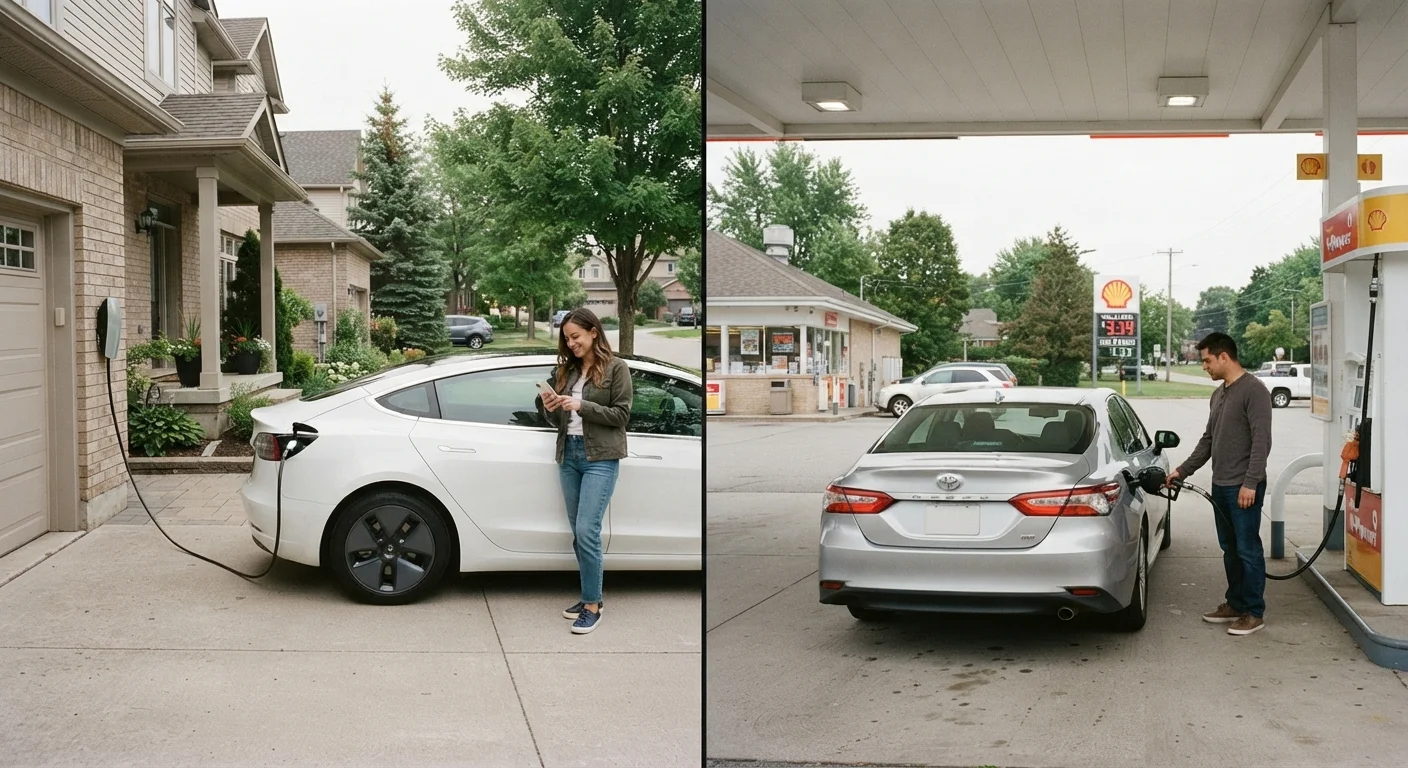
Key Takeaways
- EVs generally cost more to buy but less to fuel and maintain over time.
- Home charging access is a major factor in whether an EV delivers real savings.
- Gas vehicles carry lower sticker prices but face higher long-term fuel and maintenance costs.
- Federal tax credits can reduce EV purchase costs, though eligibility rules apply.
- Total ownership cost over five to ten years often favors EVs for high-mileage drivers.
Option A
Electric Vehicle (EV)
Higher upfront cost, lower day-to-day running expenses.
Best for: Households with predictable daily driving, access to home charging, and a longer ownership horizon.
Option B
Gas-Powered Vehicle
Lower purchase price with a well-established ownership model.
Best for: Drivers who need flexible long-distance range, lack charging access, or want a lower entry price point.
If you drive 15,000 or more miles per year and have home charging
Electric Vehicle (EV)
High annual mileage amplifies fuel and maintenance savings, and home charging keeps per-mile energy costs low.
If you frequently take long road trips without reliable charging infrastructure nearby
Gas-Powered Vehicle
Gas stations are widely distributed across the US, and refueling takes minutes rather than the time required for DC fast charging.
If upfront cost is your primary constraint
Gas-Powered Vehicle
The average new gas vehicle carries a lower purchase price than a comparable EV, and the used gas market is far larger.
If you want to reduce ongoing maintenance spending
Electric Vehicle (EV)
EVs have fewer moving parts, no oil changes, and generally lower brake wear due to regenerative braking.
If you live in an apartment or lack a dedicated parking space
Gas-Powered Vehicle
Without reliable home charging, EV ownership depends on public charging availability, which adds time and variable cost.
Purchase price and financing
The average transaction price for a new electric vehicle in the US has been notably higher than for a comparable gas-powered model. That gap has been narrowing as more mainstream EV options enter the market, but it remains a real factor for families on a fixed budget.
Federal tax incentives under the Inflation Reduction Act can offset up to $7,500 of an EV's purchase price for eligible buyers and vehicles. Income caps and vehicle price limits apply, so not every buyer or every model qualifies. Checking the IRS guidelines or asking a tax professional before assuming eligibility is worth the time.
On the financing side, a higher sticker price means a larger loan balance, which increases monthly payments even if the interest rate is identical. That monthly cash flow impact matters for household budgets regardless of how the long-term math works out. For a deeper look at how purchase costs fit into the full picture, see what the true cost of car ownership looks like for American families.
Fuel and energy costs
Electricity is generally cheaper per mile than gasoline in most US markets, though the exact margin depends on local utility rates and gas prices, both of which shift over time. A household that charges primarily at home overnight tends to see the greatest savings, since residential electricity rates are usually lower than public fast-charging rates.
Gas vehicle fuel costs are tied to pump prices, which vary by region and fluctuate with global oil markets. Drivers in areas with high gas prices tend to see a bigger relative benefit from switching to electric.
| Criterion | Electric Vehicle | Gas-Powered Vehicle |
|---|---|---|
| Average new vehicle price | Higher (often $40,000+) | Lower (broad range available) |
| Federal tax credit availability | Up to $7,500 (conditions apply) | Generally not available |
| Fuel/energy cost per mile | Lower (especially at home) | Higher (tracks gas prices) |
| Routine maintenance cost | Lower (no oil changes, less brake wear) | Higher (oil, filters, exhaust, etc.) |
| Refueling/recharging time | 20 to 60+ minutes (DC fast charge) | Under 5 minutes |
| Refueling infrastructure | Growing but uneven nationally | Extensive nationwide coverage |
| Used market depth | Smaller, prices more variable | Large, well-established |
For a more detailed comparison that also factors in hybrid powertrains, the lifetime fuel and energy cost comparison across gas, electric, and hybrid vehicles covers the long-term numbers across all three options.
Maintenance and repair
EVs have fewer mechanical components than gas vehicles. There is no engine oil to change, no transmission fluid, no timing belt, and no exhaust system to maintain. Regenerative braking also reduces brake pad wear. Over several years of ownership, these differences add up to measurably lower routine maintenance costs.
Gas vehicles, by contrast, follow a familiar maintenance schedule that most mechanics across the country can service. Parts availability is broad, labor costs vary but are generally well-established, and the repair ecosystem is mature. EVs, while simpler in some respects, can face higher repair costs for battery-related issues, and not every shop has the equipment or training to handle them.
Charging infrastructure vs. refueling access
Public gas stations number in the hundreds of thousands across the US, with refueling taking under five minutes. That infrastructure density means range anxiety is not a practical concern for gas vehicle drivers in most situations.
Public EV charging has expanded significantly, but coverage is uneven. Urban and suburban areas generally have adequate options. Rural routes and smaller towns can have noticeable gaps. DC fast chargers can add significant range in 20 to 45 minutes depending on the vehicle and charger capacity, but that is still a longer stop than a gas fill-up.
Level 1 vs. Level 2 home charging
Level 1 charging uses a standard 120V household outlet and adds roughly 3 to 5 miles of range per hour. That works for drivers with short daily commutes but is slow for larger battery packs. Level 2 charging (240V) adds 20 to 30 miles of range per hour and is what most EV owners install at home. A licensed electrician should assess your panel capacity before installation, and local permits may be required.
Home charging resolves much of this gap for drivers with a dedicated parking space. A Level 2 home charger (240V) can fully charge most EVs overnight, and installation costs typically run between $500 and $1,500 including equipment and labor, though local electrician rates vary.
Long-term ownership and resale
Gas vehicles have a well-documented depreciation curve and a large secondary market. Finding comparable sales data for used gas cars is straightforward, which gives buyers and sellers reasonable pricing confidence.
EV resale values have been more variable. Battery degradation over time is a real factor: a vehicle with a significantly reduced range is worth less than one with a healthy battery. Rapid model updates in the EV market have also pushed down used prices on earlier generations. Whether that trend continues as the market matures is unclear.
Families weighing a purchase versus a lease should also consider how powertrain type affects that decision. The buying vs. leasing comparison addresses how ownership horizon and residual value affect the total cost for both vehicle types.
Which makes more financial sense for your household?
The answer depends on driving habits, where you park, local electricity and gas prices, and how long you plan to keep the vehicle. A high-mileage driver with home charging who holds a vehicle for eight or more years is likely to come out ahead with an EV on total cost. A driver who moves frequently, lacks charging access, or replaces vehicles every three years may not recover the higher upfront cost.
The new vs. used car financial comparison is worth reading alongside this, since the used EV market now offers a way to get electric driving at a lower entry price, potentially shifting the math further in favor of electric for budget-conscious families.
$7,500
Maximum federal EV tax credit
Under the Inflation Reduction Act, eligible buyers of qualifying new EVs can receive up to $7,500 in federal tax credits; income and vehicle price limits apply.
~40%
Lower routine maintenance cost for EVs
The US Department of Energy has noted that EV owners generally spend less on maintenance than comparable gas vehicle owners, largely due to fewer mechanical service requirements.
60,000+
Public EV charging ports in the US
The US Department of Energy's Alternative Fuels Station Locator tracks public charging availability, which has grown substantially but remains unevenly distributed geographically.
This article is for general informational purposes only and does not constitute financial or purchasing advice. Vehicle pricing, incentive eligibility, and infrastructure availability change over time. Verify current figures with manufacturers, the IRS, and local utility providers before making a purchase decision.