

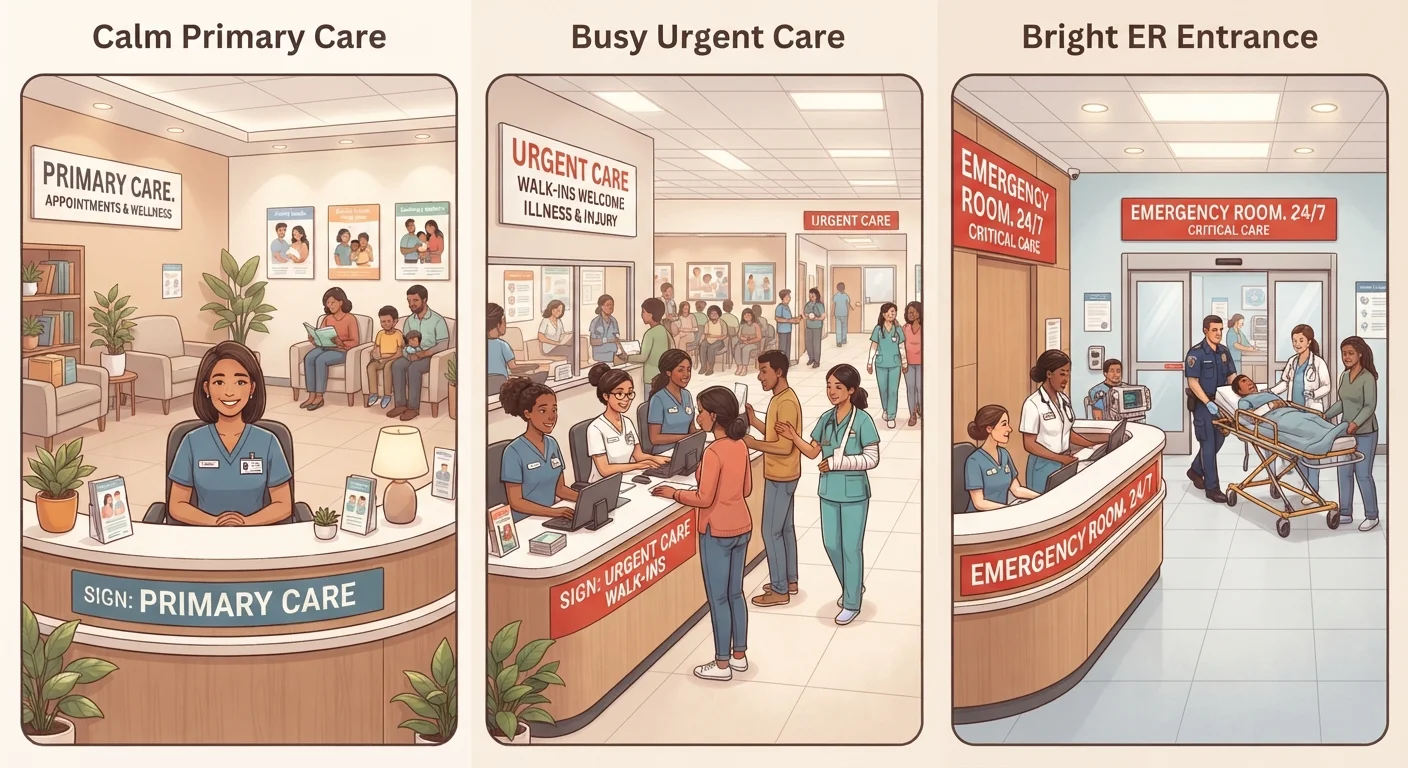
Key Takeaways
- Emergency rooms are for life-threatening conditions; using them for minor issues costs significantly more.
- Urgent care centers handle non-emergency problems that cannot wait for a scheduled appointment.
- Primary care providers are best for routine, preventive, and ongoing health management.
- Cost differences between the three settings can be substantial, even with insurance.
- When symptoms are ambiguous, calling your insurance nurse line or primary care office can help you decide.
Our Verdict
For most non-emergency situations, primary care is the most cost-effective and medically thorough option. Urgent care fills the gap when your regular provider is unavailable and the condition is not life-threatening. The emergency room should be reserved for situations where delay could cause serious harm.
| Best for | Recommended |
|---|---|
| Routine checkups, chronic disease management, and preventive care | Primary care |
| Same-day non-emergency needs when a primary care appointment is unavailable | Urgent care |
| Chest pain, difficulty breathing, severe injuries, or any potentially life-threatening symptom | Emergency room |
| Minor illnesses or prescription refills when leaving home is difficult | Telehealth (see related guide) |
What each setting is designed to do
These three care settings exist for different clinical purposes, and using the wrong one affects both your health outcome and your bill.
Primary care covers ongoing health management: annual physicals, vaccinations, chronic condition follow-up, and non-urgent new symptoms. Your primary care provider (PCP) holds your medical history, coordinates specialist referrals, and manages prescriptions over time. For families building long-term health habits, this relationship is where most care belongs. If barriers like cost or scheduling make it hard to keep those appointments, common reasons families skip annual checkups covers practical ways to address each one.
Urgent care centers treat conditions that need same-day attention but are not life-threatening: ear infections, minor lacerations, sprains, urinary tract infections, and flu symptoms. Most are open evenings and weekends, accept walk-ins, and return patients within one to two hours.
Emergency rooms are staffed and equipped for medical crises: stroke symptoms, chest pain, severe allergic reactions, major trauma, and conditions that could deteriorate quickly without intervention. ERs operate around the clock and can run imaging, labs, and surgery on-site.
How costs compare across the three settings
Cost is one of the most consequential differences for families. According to the Health Care Cost Institute, the average ER visit costs several times more than an urgent care visit for the same complaint. A typical urgent care visit for a minor illness runs from roughly $100 to $200 without insurance; the same visit to an ER can exceed $1,000 before facility fees are added.
Insurance coverage varies by plan. Most plans apply a higher copay or coinsurance rate to ER visits, and some plans waive the ER cost only if the visit results in admission. Urgent care copays are generally closer to a specialist copay level. Primary care visits typically carry the lowest copay of all three, and preventive visits are often covered at no cost under the Affordable Care Act.
| Primary care | Urgent care | Emergency room | |
|---|---|---|---|
| Best for | Routine, preventive, chronic care | Same-day non-emergency issues | Life-threatening emergencies |
| Typical wait time | By appointment, same day possible | 30 min to 2 hours walk-in | Varies; critical cases first |
| Relative cost (no insurance) | Lowest | Moderate | Highest |
| Hours | Business hours, some extended | Evenings and weekends | 24 hours, 7 days |
| On-site capabilities | Labs, basic imaging | X-ray, labs, IV fluids | Full imaging, surgery, ICU |
| Access to medical history | Full history on file | Limited unless shared | Limited unless records sent |
If your plan uses a deductible-first structure, the dollar difference between settings is even larger until your deductible is met. Checking your plan's Summary of Benefits before a visit, or calling the member services number on your insurance card, takes only a few minutes and can prevent a large surprise bill.
Matching your symptom to the right setting
The clearest guide is severity. Go to the ER for any symptom that could signal a serious, fast-moving condition: chest pain or pressure, trouble breathing, sudden severe headache, signs of stroke (face drooping, arm weakness, slurred speech), heavy uncontrolled bleeding, loss of consciousness, or severe burns. For children, high fever in an infant under three months and any sign of respiratory distress also warrant an ER visit.
Urgent care is appropriate when the problem needs attention today but does not fit those criteria: a sore throat with fever, a minor cut that needs stitches, a suspected sprain after a fall, pink eye, or a mild asthma flare that responds to your rescue inhaler. Many urgent care centers now handle basic X-rays and IV fluids, expanding what they can manage on-site.
Primary care is right for anything that can wait a few days, anything chronic or recurring, and anything requiring a specialist referral or prescription management. If you are unsure whether your situation can wait, call your PCP's office. Most practices have a nurse triage line that can advise you without requiring an appointment.
Telehealth has grown as a fourth option for many low-acuity situations. When telehealth works well and when it does not offers a full breakdown of which conditions it handles well and when an in-person visit is necessary.
Practical steps for families
A few habits reduce the chance of landing in the wrong setting under pressure.
- Keep your PCP's after-hours number and your insurance member services number saved in your phone. Both can guide triage decisions at no cost.
- Identify the urgent care center closest to your home and confirm it is in your insurance network before you need it.
- Know your plan's ER policy. Some plans require notification within 24 hours of an ER visit; others have specific non-emergency ER exclusions.
- For children, ask your pediatrician whether the practice has after-hours or weekend availability before a sick visit becomes an urgent care trip by default.
When a situation is genuinely unclear, err toward a higher level of care. No financial consideration outweighs a missed cardiac event or delayed stroke treatment. The cost guidance here is for situations where the severity is already clearly low.
This article is for general informational purposes only and is not a substitute for professional medical advice, diagnosis, or treatment. Always consult a qualified healthcare provider for questions about a specific medical condition or before making decisions about your care.