

Key Takeaways
- NHTSA and IIHS run separate testing programs with different methods and scoring systems.
- A five-star NHTSA rating does not automatically mean an IIHS 'Good' rating, and vice versa.
- Safety ratings cover crash protection, crash avoidance technology, and headlight performance.
- Ratings can affect insurance premiums, since insurers track real-world claim data tied to specific models.
- Checking both programs gives a more complete picture of how a vehicle performs in a collision.
Vehicle safety ratings
Vehicle safety ratings are scores assigned to cars, trucks, and SUVs after they are subjected to controlled crash tests and safety inspections. Two organizations run the major programs in the United States: the National Highway Traffic Safety Administration (NHTSA) and the Insurance Institute for Highway Safety (IIHS). Each uses a different set of tests and a different scoring system, so a vehicle can perform well in one program and poorly in the other.
NHTSA uses a 1-to-5 star scale across multiple crash categories, while IIHS uses a descriptive rating system (Good, Acceptable, Marginal, Poor) plus a separate Top Safety Pick designation.
The two organizations behind U.S. safety ratings
When you look up a vehicle's safety record, you will almost always encounter results from two sources: NHTSA (the National Highway Traffic Safety Administration) and IIHS (the Insurance Institute for Highway Safety). They are independent of each other and use different tests, which is why comparing scores across both programs matters.
NHTSA is part of the federal government. Its New Car Assessment Program has rated vehicles since 1978 and assigns one to five stars in each of several crash categories, including frontal impact, side impact, and rollover resistance. A vehicle's overall star rating is a summary of those individual scores.
IIHS is a nonprofit organization funded by auto insurers. It began publishing ratings in 1995 and expanded significantly in the years since. Rather than stars, IIHS uses four descriptive grades: Good, Acceptable, Marginal, and Poor. Its tests include a small overlap frontal crash, a moderate overlap frontal crash, side impact, roof strength, and head restraint performance, among others.
Neither program tests everything
NHTSA and IIHS each cover a specific set of crash scenarios, and neither program claims to replicate every possible collision. For example, rear-impact testing is handled differently across the two programs, and not all vehicle categories receive identical test batteries. Checking scores in both programs gives more coverage than relying on one alone.
Because neither program covers every possible collision scenario, a vehicle that scores well in both programs has cleared a wider range of safety benchmarks than one tested by only one of them.
What crash tests actually measure
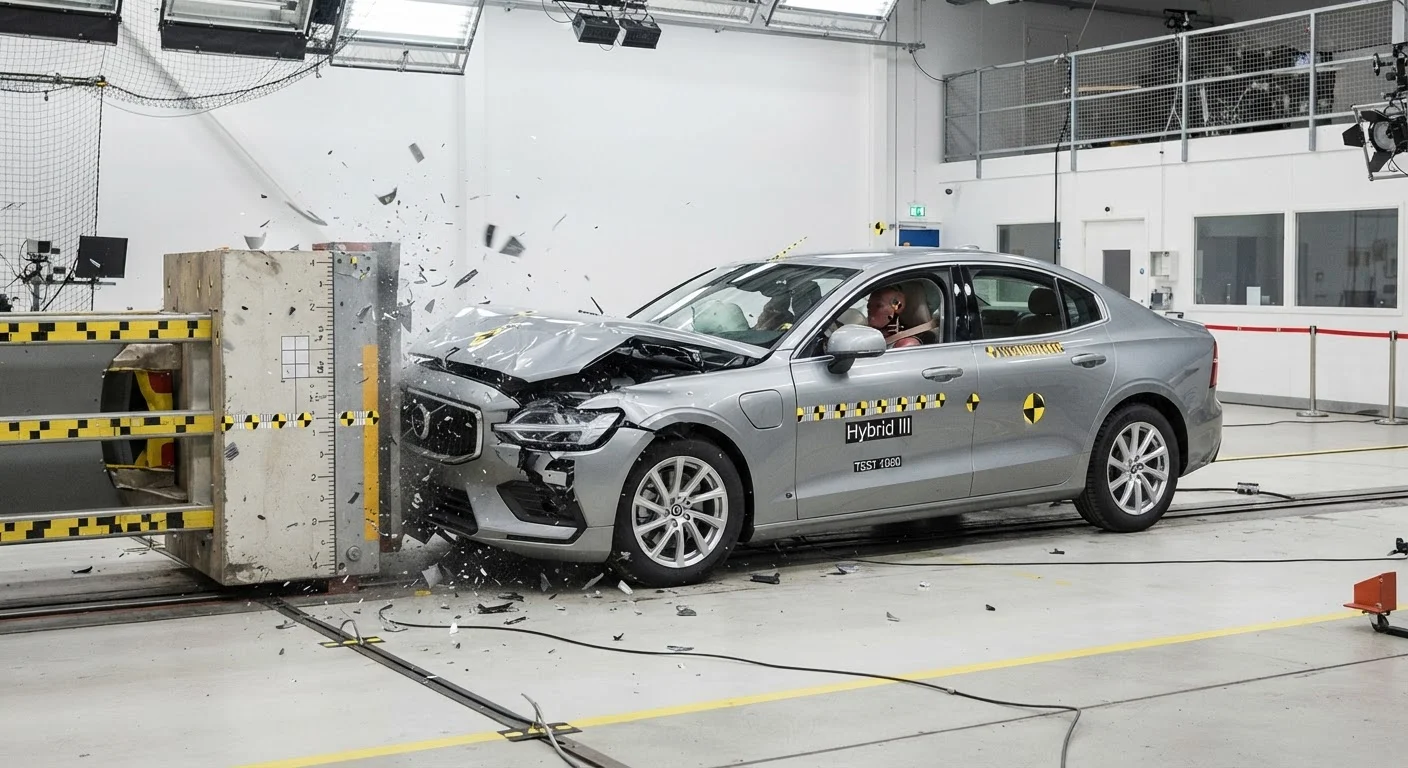
Each test is designed to replicate a collision type that causes real injuries on public roads. NHTSA's frontal test drives a vehicle into a barrier at 35 mph. Its side test uses a moving deformable barrier to simulate another vehicle striking the door panel. The pole test, added later, simulates a car sliding sideways into a fixed object like a utility pole.
IIHS runs a small overlap frontal test, where 25 percent of the vehicle's front strikes a rigid barrier at 40 mph. This test was added because full-width frontal tests were missing a common real-world crash pattern. The institute also evaluates roof crush resistance, which matters in rollover crashes.
Both programs measure occupant injury risk using sensors inside crash test dummies placed in the driver and passenger positions. Sensors in the dummies' heads, necks, chests, and legs record force and motion data that engineers use to estimate injury probability.
38,893
U.S. traffic fatalities in 2020
According to NHTSA data, this represented the highest number of road deaths in over a decade, reinforcing why standardized safety testing matters.
25%
Overlap used in IIHS small overlap frontal test
The IIHS introduced this test after finding that a significant share of real frontal crashes involved only a portion of the vehicle's front end.
40 mph
Speed used in IIHS small overlap frontal test
IIHS conducts this test at 40 mph to replicate a common real-world collision speed for serious frontal crashes.
Crash avoidance and headlight ratings
Modern safety programs go beyond measuring what happens during a crash. IIHS rates front crash prevention systems, which use cameras or radar to automatically brake or warn the driver before a collision. It also rates headlight performance separately, since poor headlights are a documented factor in nighttime crashes.
NHTSA evaluates advanced driver assistance systems under its 5-Star Safety Ratings program and its separate NCAP roadmap, which has been expanding to include automatic emergency braking assessments.
Headlight ratings deserve particular attention because a vehicle can earn strong crash test scores while still having headlights that illuminate the road poorly. IIHS rates headlights on individual trim levels, so the same model can have Good-rated headlights on one trim and Marginal-rated headlights on another, depending on the light technology installed.
How to read ratings when researching a vehicle
Start at nhtsa.gov and iihs.org and search the exact model year you are considering. Ratings are not always consistent across years, since automakers update vehicle structures and safety systems during a model's production run.
Look at individual test scores, not just overall ratings or summary designations. A vehicle with a five-star NHTSA overall rating might have earned four stars in a specific side impact test. Similarly, an IIHS Top Safety Pick+ vehicle might have a weaker headlight rating on its base trim.
If you are comparing two vehicles and one has strong scores in both programs while the other has mixed results, that gap is worth factoring into your decision. Insurance costs, resale value, and most importantly occupant protection can all be affected by where a vehicle lands on these scales.
This article is for general informational purposes only. For specific safety questions about a vehicle you own or plan to purchase, consult the manufacturer and official government resources.